
BREEDER SPOTLIGHT: Jaz Ranch


BREEDER SPOTLIGHT: Jaz Ranch
Tell our audience about the history of Jaz Ranch. When did you begin your breeding program?
What horses were you breeding? Where was your ranch located? How many horses did you produce?

Strangely the Jaz Ranch Ameritano (Lusitano crossed on an NFQHA horse) breeding program really began with the purchase of an AQHA stallion, Poco Bueno grandson, Pocos Gray Comet, (left) in 1990. Brent and I were recreational riders, loved horse packing into the mountains, and had raised a few foals as a hobby; but had no plans to become ‘breeders’. However, when we had the opportunity to purchase ‘Poco’ we leapt at the chance, and began the evolution of our 36 year horse breeding program.
Once he was ours, we could not believe his disposition, willingness, kindness, and athletic ability. In talking with other people that had similar bred horses we discovered that their horses exhibited the same wonderful attributes as Poco which led us to research foundation Quarter Horses.
To make a long story short we ended up buying fourteen Poco Bueno granddaughters (our Mail Order Brides) from all across the nation, as well as another incredible stallion, Little Steel Dust (42% Poco Bueno), who became our Foundation sire. We began our official Foundation Quarter Horse breeding program in Nevada in 1990. Our babies were seemingly born halter broke, loved people, were athletic, smart, and beautiful, and in great demand by those interested in the original old bloodlines.
In 1994, we formed the National Foundation Quarter Horse Association, www.nfqha.com, in order to help preserve the horse AQHA was originally formed to preserve, but which was being replaced by the modern Quarter Horse that carried a lot of Thoroughbred blood. A horse is researched back 11 generations with a custom computer program, and must carry a minimum of 85% Quarter Horse Blood in order to qualify as an NFQHA Foundation Quarter Horse (less than 15% Thoroughbred). NFQHA has researched over 49,000 horses and has members in all states and many European countries as well as Australia, and Brazil, etc.
When did you first become involved with Lusitanos? Describe your beginnings.
In 1995 we moved our ranch from Lamoille, Nevada to beautiful Joseph, Oregon and became acquainted with a Lusitano breeder who also loved Poco Bueno horses. She had an 800-acre ranch in Oregon, with 150 Lusitanos that included some top Stallions. When she was involved in a tragic accident, that required a long rehab at her home in Washington state, she asked for our help and we were introduced to the Lusitano horse, and were captivated by them.
In 2009 I saw an ad for a Lusitano weanling owned by Sherry Mohr in New York and shocked Brent by saying we should buy him. In turn, Brent shocked me by saying he thought it was a good idea! The weanling was E-Preto, a black APSL stallion by Damasco. We thought we would have a lot of time to slowly find a few mares and develop a Lusitano program while Preto was growing up and getting a show record - never dreaming that we would soon have the opportunity to buy the legendary Grand Prix Jumper and talented Bullfighting stallion, Halconero.
‘Hawk’ was 19 years old and a proven sire of performance horses, and we had already fallen in love with him before he came up for sale. After getting Hawk we acquired several Lusitano mares and were suddenly in two breeding programs, NFQHA horses and purebred Lusitanos! In the following years we continued to breed outstanding NFQHA horses and sold horses into all 50 states and many European countries, while establishing our Lusitano program.

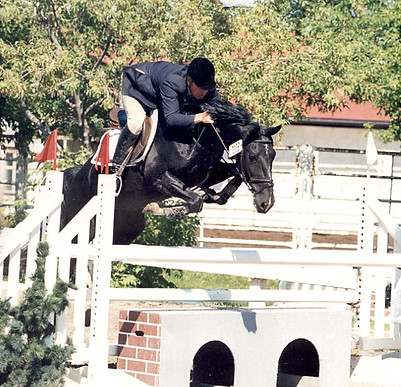
Halconero
In this paragraph you can include any content you would like to share with the user. Just click "Edit Text" or double click to add your own text and make changes to the font.

In 2014 we again moved our entire ranch, this time to Utah to be closer to family. Moving to the high desert in Levan, Utah where the land was not as productive as in Oregon made it necessary to downsize program to accommodate the land. Little Steel Dust had passed at 29 years old, and in thinking about how to keep both the purebred Lusitanos and our beloved NFQHA girls, we came up with the concept of crossing our Foundation QH mares on E-Preto while waiting for the first Hawk daughters to come of breeding age.
We decided we would try the cross for one year and if it did not turn out the way we envisioned, we would not continue with the cross. The plan was that the short, wide, heavily muscled NFQHA mares would add more bone and body to the Lusitano, and the Lusitano would add more height, and more elegant movement to the NFQHA horse. We were sure the result would be an athletic, people-oriented horse with a great disposition as both breeds would contribute those traits - and the Foundation Quarter Horse would tone down the Lusitano a bit.
In 2018 we retired E-Preto from the show ring and brought him home to pasture breed the NFQHA mares. The rest is history as they say. The cross was magic and far exceeded our expectations. The offspring were beautiful, super smart and willing, great to train, and very affectionate. We named the new cross ‘Ameritano’ for the American Quarter Horse and the Lusitano. We have also started an Ameritano registry, www.Ameritano.com to encourage more breeder interest in this special cross. To qualify as an Ameritano a horse must have one Lusitano parent and one NFQHA registered parent.
The Ameritanos we have sold are all still young but have already been used for everything from dressage and working ranch horse to roping, and have even been on the 200 mile John Wayne ride! The owners absolutely love their Ameritanos and several owners have come back to buy one or two more! We feel that is the definitive test for whether the cross is a success!


How are your horses kept?
Jaz Ranch is an avid believer in socializing horses naturally and all our babies are kept in a herd as long as possible, only separating them for interval handling and training. We believe that horses raised in a herd are much better adjusted and socialized with less anxiety.
Describe when you begin training and the methods used.
Our babies are handled from birth, and most are sold before they are two years old. They have basic handling including moving off pressure, desensitizing to ropes, flags etc., handling feet, loading, and negotiating obstacles. They are trained intermittently giving them time to just be horses and hang out with their friends in the same age groups. Our goal is to raise a confident young horse that likes people, is receptive to training, and is ready to advance their career.
Above: Current APSL approved breeding stallions Onasis das Faias (Imported from Portugal) & Xerez de Quintana, (imported from Brazil). Frozen semen is also available from Halconero.
What are your goals as a breeder? What qualities are you selecting for?
Jaz Ranch values disposition and intelligence foremost. Any discipline benefits from an intelligent horse that wants to work with you. Of course we want beautiful babies too, but a beautiful horse without a good mind and disposition is not a desirable partner. The cross of E-Preto on the NFQHA mares produced all of those attributes and we were devastated in 2024 when we lost Preto to a tragic accident in the prime of his life. We had always thought that we would age out before he did.
After looking for months for a replacement stallion we were contacted by a friend about a son of the famous Olympic stallion, Escorial, that had just come on the market. We immediately contacted the owners, Robert and Jill Malone of Cielo Lusitanos and bought Onasis das Faias the next day. He is a very special imported APSL stallion with a wonderful disposition and presence. He is very modern looking with stunning movement and we are extremely excited about the two Ameritano foals we expect by him this spring, as well as three APSL foals out of Halconero daughters.
We were also fortunate to acquire a lovely imported APSL retired show stallion, Xerez de Quintana from Janice Cline. Xerez is Grand Prix and a sweetheart. This spring we are looking forward to one Ameritano and two APSL foals sired by Xerez (out of a daughter of Hawk and a daughter of Escorial).
In this paragraph you can include any content you would like to share with the user. Just click "Edit Text" or double click to add your own text and make changes to the font.

Xerez de Quintana


Do you breed for any specific disciplines?
We think every horse should be versatile and we do not breed for specialty horses. That being said, most of our Lusitanos are bought by dressage enthusiasts and we have bred many performers. The Ameritanos go to people with many interests, from trail riding, dressage, working equitation, ranch and cow work, and really anything people can think of.
What do you consider to be the most important characteristics in the breed and why?
For the Ameritano the most important characteristic is their versatility and their desire to please and be with people. We strive to produce horses that will bring years of enjoyment to their owners.
How important is temperament as you evaluate/access your breeding stock?
Temperament is paramount in both of our programs. In the 36 years we have been breeding horses we have started with horses that we like and appeal to us personally, and keep their offspring to continue each program. The true test comes with what they produce
How many foals do you typically produce every year?
Jaz Ranch normally produces 8 to 12 foals a year.


What advice would you give or first time buyers & newcomers to the breed ?
Look for a youngster that you are drawn to for their looks and personality and do not overthink it. Rely on what you see in the breeding program and accept that the young horse will go through several different stages before reaching maturity. The Lusitano matures slowly and people new to the breed should expect to have patience while they go through various growth stages.
The main understanding I would like to impart to those new to both breeds is that these horses are very sensitive, smart and level headed. They love to learn, want to please, and will give you everything when treated with love and respect, tempered with the firm but gentle hand of a leader. I would caution new owners to not skip any steps in their ground work education, and to progress steadily so the horse does not get bored.
What about line breeding vs. outcrossing?
All of our Foundation Quarter horses are tightly Poco Bueno line-bred and breed true every time. We consider the NFQHA mares to be the secret ingredient in this phenomenal cross, and bred to a Lusitano they have produced incredibly consistent, typey offspring. Many top foundation APSL horses have been linebred but we have not tried it. The old adage is “If it works it is linebreeding – if it doesn’t work it is inbreeding”. We agree with that, but there can be a degree of risk and you have to be willing to take a loss and change your direction if close-breeding doesn’t work.
What are the biggest changes you have witnessed in the breed (in the USA)?
The Ameritano is new, so it is too early to see what will happen with the breed. However, we have seen a concerted effort to breed for bigger Lusitanos to compete with the Warmbloods in the lower dressage levels. We would not like to see the height of the Lusitano exceeding the breed standard, nor do we want to see the amazing athletic ability of the Lusitano sacrificed for size and a longer stride. The Lusitano is a talented dressage horse in all levels, and a standout in the higher levels where the difficult moves call for extreme balance and athletic ability.

JAZ RANCH LINKS